
Recording breeding evidence codes

Displaying Ruff – a great piece of breeding evidence that should be recorded and submitted, using the evidence code D. (credit: Colin Bradshaw).
We have recently posted videos and blogs about recording rare breeding birds, firstly about how to submit records, and subsequently about what information those records should contain to be as useful as possible. In these we have touched on ‘breeding evidence’, the information what breeding activities birds were observed doing. This third blog (and accompanying video) gives greater detail on this, and how to use the breeding evidence codes that are used to classify breeding evidence.
Breeding evidence codes provide a simple and standardised way to capture what you’ve observed that everyone will understand. They are grouped into three classes of possible, probable and confirmed breeding. A confirmed breeding record refers to a breeding attempt where eggs were laid – even if those eggs didn’t hatch, or the breeding failed at some other point, this is regarded as confirmed breeding.
Here are the evidence codes, with a bit of detail on their use, in ascending order. Record the ‘best’ evidence code you see, based on the order given below – so B. (nest building) is better than P. (pair) for example. But for all records you submit it’s possible, and often valuable, to include text giving more details covering all the breeding evidence you might have observed.
Possible breeding evidence codes
At the bottom, the weakest evidence of breeding, is code H., a bird in suitable breeding habitat. An individual bird, in the breeding season for that species, can be regarded as a possible breeder if in suitable breeding habitat. Care should be taken not to use this for birds likely just to be a migrants passing through – for example a Wood Sandpiper on a bog in the Highlands could be regarded as a bird in breeding habitat, but the same species on a marsh in England would just be a migrant passing through. Using H. appropriately does require a bit of knowledge about habitat use and breeding range, and can be a bit subjective – if in doubt seek advice.

A singing Marsh Warbler (credit: Gary Woodburn).
The other possible breeding record is a singing male, S., again only if it’s in suitable habitat and not an obvious migrant. So if you come across a singing Cirl Bunting, hear a booming Bittern or a hooting Long-eared Owl, include an S. in your record submission. BirdTrack and eBird have drop down lists for breeding evidence to make this really easy for whatever code you have observed.
Probable breeding evidence codes
Next, we move to the larger number of evidence codes grouped as probable breeding. An important thing to clarify is that the category label ‘probable’ can cause a bit of confusion. You might observe one of the relevant evidence codes, but also know that birds involved did not actually breed – for example a pair of Black-winged Stilts was present on a local wetland for a while, maybe even built a nest scrape, but then left before laying eggs – they didn’t breed. Therefore you might think ‘that’s not probable breeding because I know for a fact they didn’t breed!’. But in this system the ‘probable’ terminology can be a bit misleading – those Black-winged Stilts would still count as a probable breeding attempt. I have often thought it would be a bit better if this long-established system used a different label – if it were evidence levels ‘low’, ‘medium’ and ‘high’, for example. Basically, if you record one of these next evidence codes, it does count as probable breeding.

A pair of Common Scoters in breeding habitat, a loch in North Scotland. This is a valuable sighting and the submitted record should include the sexes of the two birds and the breeding evidence code P. (credit: RSPB Images).
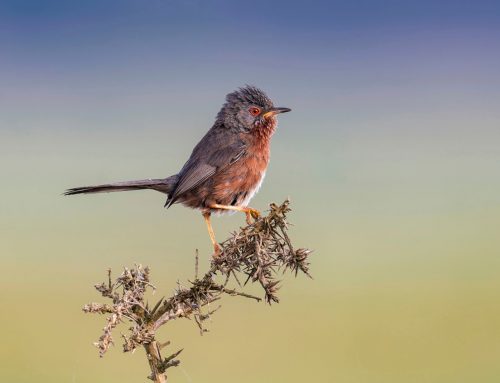
A pair, P., simply a pair present in suitable habitat in the breeding season – not just two birds, but a male and female. While this may be easy to determine for sexually dimorphic species (in which the sexes look different) such as Shovelers, it may need to be inferred if you can’t tell the sexes apart in the field. Two Dartford Warblers in close company, with no antagonism, might be safely interpreted as a pair, for example.
A territory, T. – birds present displaying territorial behaviour such as singing at the same place on two dates or more at least a week apart. So, if you found a singing Redwing, recorded it as S., but returned a fortnight later (which we hope all observers would do if they find such interesting and valuable records!) and found that it was still there singing, you should then upgrade the record to a T.

A pair of Marsh Harriers talon-grappling – clearly displaying, so evidence code D. (credit: Mark Eaton).
Displaying birds, D. – regarded as a step up from simply singing, this should be used for individual or multiple birds – might be multiple males, or a pair together – indulging in display whether that is perched (e.g. lekking) or in display flights.
Birds visiting a probable nest site, N., is used when birds appear to be visiting a nest site but higher evidence codes such as nest building (B.) or carrying food (FF), cannot be used. This might be individuals examining a nest hole, for example.
Agitated behaviour or alarm calls, A., suggests that birds may have a nest or young nearby. This can be quite a frustrating one to use as it’s often in circumstances where you suspect but can’t quite confirm breeding. Of course, all observers should be acting to avoid disturbance and anxiety to breeding birds, and follow wildlife legislation, so you should avoid causing unnecessary disturbance and alarm.
I. is the code for a brood patch on an adult bird – this is really only one for ringers who might find a brood patch (the bare patch on the belly that helps keep eggs warm) on a bird in the hand, indicating that it is currently incubating.
And finally, the last probable breeding code is B., for nest building or nest-hole excavating. For example, birds carrying feathers or sticks in the early part of the breeding season should be recorded as B.
Confirmed breeding evidence codes
DD refers to distraction display or injury feigning, and is one of the less frequently used codes. It refers to those species that will display very high levels of agitation that indicates they have young, and do these remarkable displays of pretending to be injured to lure predators away from those young. It’s mostly waders such as Dotterel, for example, that do this – some waterfowl may also do it.
UN stands for used nest, or eggshells, as long as you believe they came from the most recent breeding season and are not years old. This is often a good way to confirm breeding for divers, for example, by finding vacated nest scrapes on the edges of lochs at the end of the breeding season.

A young Dotterel chick. Although this bird has not fledged, as the downy young of a nidifugous species it should be recorded as FL (credit: Colin Richards).
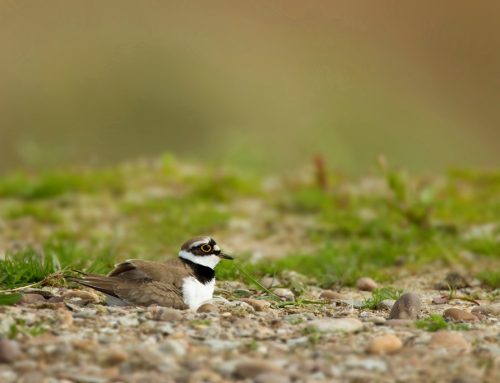
FL is a slightly confusing code, as it covers both recently fledged young (hence FL), but also downy young of nidifugous species (the chicks of waterfowl and waders that leave the nest shortly after hatching, from the Latin for “nest” and “to flee”). These chicks should be counted under the evidence code FL, even though they can’t fly so haven’t fledged. The key thing to consider when using this code, particularly for you that have fledged, is whether the young birds have come from the site itself, or whether they may have come in from a breeding attempt elsewhere, already dispersing. This is a matter of judgement informed by factors such as how old they are, how strongly they can fly, whether they are still in a family party, or perhaps still being fed by parents. Have birds been present at the site earlier in the breeding season? If you find a juvenile Little Ringed Plover on its own at a site where you haven’t seen adults earlier in the year, it shouldn’t be counted as the chances are it hasn’t hatched at this site.

This Purple Sandpiper is sitting tight on the nest. Undoubtedly it has eggs, but given we can’t see them this could be recorded as ON (credit: Colin Richards).
ON is for occupied nest – birds entering or leaving a nest site indicating the nest is being used – which might be a nest hole, or a nest high up that you can’t see in to so don’t know what’s in the nest. It might also include birds incubating where you can’t actually see the eggs, such as an Avocet sitting tightly on a nest scrape.
FF – adult birds carrying food for the young, making long flights carrying that food – so not just a raptor carrying a prey item to a perch to eat it. Or, in the case of passerines, birds carrying faecal sacs away from the nest indicating they have young.

A Eurasian Wigeon nest with a clutch of eggs, so evidence code NE (credit: Colin Richards).
NE – a nest containing eggs. Remember that we do not encourage the disturbance of rare breeding birds to record this, unless you are doing so as part of formal monitoring such as the BTO’s nest record scheme, and for most rare breeding birds you will be breaking the law unless you have a specially-issued Schedule One licence.
And finally, NY – a nest with young in it – which in some cases might include young heard rather than seen, from a nest hole for example.
So, there you have it. Try to learn the most important ones – H. for habitat, S. for singing, P. for pair, D. for display, FL for fledged or down young out of the nest, ON for occupied nest, NE for nest with eggs and NY for nest with young. Please remember to add these to your records, however you submit them, and instantly make them more valuable for county reporting and the national level work of the Rare Breeding Birds Panel in supporting the conservation of our rare breeding birds.
And one last thing… breeding season fieldwork for the next Britain and Ireland bird atlas starts in the spring of 2028. Recording breeding evidence codes are a vital part of atlasing (it’s what they were first developed for), so now is a good time to be brushing up your knowledge ready for the atlas!