
Confirming breeding in rare breeding birds: what to look for

About as exciting as confirming breeding can get… a male Red-spotted Bluethroat feeding its recently fledged offspring on a Scottish mountain. Evidence code FL (Robert Ince).
I write this in the second half of June, and we have indisputably moved from spring into summer, and the breeding season is very well progressed. It remains a great time for finding and recording rare breeding birds, with many species right in the thick of their breeding seasons even if a few may have finished already. It is also a fantastic time to be confirming breeding attempts in rare breeding birds, perhaps by returning to sites where birds have been found earlier in the season to ‘upgrade’ records. In RBBP terms, as with bird atlases, a confirmed breeding attempt is any pair of birds laying eggs – it doesn’t require that breeding attempt to be successful, i.e. fledging young, to be regarded as confirmed breeding.
In this blog I thought I’d write about some of the evidence that can be used confirm breeding in RBBP species, and how what you should look for might vary between species. As always, please remember to put the welfare of breeding birds first, avoid unnecessary disturbance, and remember the law – it is illegal to disturb bird species listed on schedule one of the Wildlife and Countryside Act (1981) at or near the nest without a licence to do so.

A female Shoveler with ducklings – a sure-fire confirmation of breeding at this site, evidence code FL (Mark Eaton).
And of course, I’m writing this as I want readers to submit records with details of breeding evidence – as well as all the other information such as precise location and numbers of breeding birds – so please do. Remember to add evidence codes in data submissions, such as those made via BirdTrack or eBird. And of course, if you have counts of eggs, birds in nests or fledged birds, then that’s really valuable data to include as well.
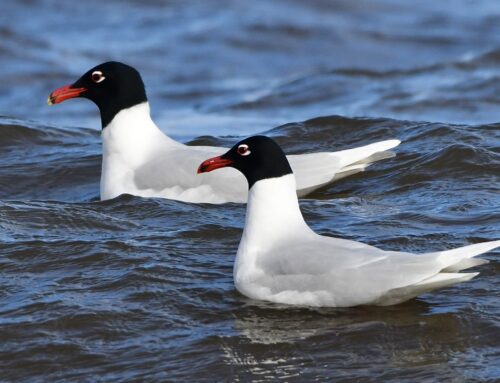
So, what can you look for to confirm breeding in a RBBP species? Obviously, eggs in the nest (evidence code NE) is evidence of a confirmed breeding attempt – but there aren’t many species for which this is easy to see without disturbing breeding birds. Recording an occupied nest (evidence code ON) is often easier – an adult bird sitting on a nest or scrape, incubating eggs. A Little Ringed Plover sitting tightly on an expanse of shingle, a Peregrine on a cliff ledge, seabirds such as Mediterranean Gulls in a colony. This evidence code can also be used for birds seen entering nest holes, or high nests that can’t be seen into, in a manner suggestive that they are incubating or feeding young.
But for many species the nests are hidden away and rarely found and the best chance of breeding evidence comes later, after eggs have hatched. For some species this might be a lot later – by finding signs of breeding after birds have left the nest – breeding by Red-throated Divers, for example, can be proven by finding eggshells in abandoned nest scrapes at the end of the season (code UN).

Although the eggs can’t be seen, a Little Ringed Plover settled on a nest scrape like this can be regarded as evidence of ON, occupied nest (RSPB Images).
Another way of proving breeding is to look for adult birds carrying food – code FF. Most birds don’t carry food around unless they’re taking it to their young – even birds of prey only usually carry food a short distance if they’re planning to eat it themselves. So a Goshawk heading purposefully with a prey item will be taking it back to the nest, as will a warbler with a beakful of caterpillars. For some species it’s possible to use this code even if the food cannot be seen – a Bittern repeatedly flying into the same patch of reedbeds is making feeding flights to the nest site. Occasionally you might also prove breeding with a bird going the other way – a passerine with a bright white parcel in its bill is removing a faecal sac from the nest – that’s also code FF.
Same as you might encounter birds incubating on nests, you might also see young in nests – for seabirds, egrets, raptors. Or maybe just hear them, if you can’t see into the nest – no matter, this is still evidence code NY, a nest with young.

A male Lesser Spotted Woodpecker approaching a nest hole – clearly an occupied nest, ON. Better still, the bird has a beakful of food – that’s FF. And if it’s possible to hear the young begging from within the nesthole, that’s evidence of NY, a nest with young (Richard Jacobs).
Of course, there are many nidifugous species – those in which the downy young leave the nest immediately or shortly after hatching and forage for themselves. For many species of ducks and waders this is the best way to prove breeding – for many secretive species it’s hard to do it any other way. For many nidicolous species – those that raise the young to fledging in the nest – seeing recently fledged young can be the easiest way to confirm breeding. There’s a slight complication here – with nidifugous young seen while still flightless, you can be confident of breeding in that location, or near enough – but for fledged birds you have to make a judgement on whether they have come from that site, or are they old enough to have dispersed from elsewhere. A little bit of judgement may be required – ask yourself are they at a site where you’ve seen adults earlier in the season, how strongly can they fly, are they still in a family party and being fed by their parents? Slightly confusingly, both fledged young, and the downy young of nidifugous species should be recorded under evidence code FL, even though those precocious nidifugous young might not have fledged yet.

Young Black Redstarts can pose a puzzle, as recently-fledged juveniles can appear at sites where no adults have been sighted earlier in the season – have they come from a undiscovered pair in the vicinity, or dispersed from elsewhere? Ones still begging for food from parents, like this one, are very likely to have come from a nearby nest (Adrian Dancy).
Finally, one last code to mention, that’s DD – adult birds giving distraction displays, or showing high levels of alarm indicating thy must have a nest or young nearby. Be careful only to use this when birds are clearly very agitated, as many species will alarm call even if they don’t have an active nest or young.
So there you are, there’s a challenge for the next month or two – how many of your records can you upgrade from possible or probable to confirmed? It might take some perseverance, and skill, and in some cases it’s really dependent on the birds – for some species it’s very difficult if they don’t succeed in fledging young, and of course many pairs of rare breeders may simply not progress as far as laying eggs. But it can be really satisfying to be able to prove confirmed breeding, and is the mark of a top rare breeding bird recorder! Good luck!